Promethean Ambitions: Chapter 2 (p.63~p.114) Summary

In the latter half of the second chapter, Newman discusses the authors and philosophers who argued in favour of alchemy and its ability to transmute base metals into a more precious one. A few prominent figures are discussed, followed by more attacks against the legitimacy of transmutation during the 13th– 16thcenturies. We will look at the few figures that set the scene for the proponents of transmutation, followed by arguments against them. Since there are many writers mentioned, I will pick and choose the authors and books that best describe the supporting views for alchemy and the refutations against them. I will then end this chapter with the introduction of Paracelsians and the refutations raised against them by Erastus.
In enumerating the views in favour of alchemical transmutation, the first in order is Book of Hermes, which is a number of manuscripts from the late 13thto the early 14thcentury, that plays a significant role in advancing the argument that what is produced by means of human agency does not differ from those produced in nature. Book of Hermesadvances primarily three theses and they are as follows. First, it argues that human works are the same as the natural ones since it often appears to be the case that things found in nature such as fire, trees and bees are essentially the same when produced by means of human agency. This is because everyone would agree that the fire produced of natural lightening is not essentially different from the fire thrown forth by a stone, or that natural wild trees are the same with artificially grafted trees. Even bees generated spontaneously from a decomposing bull are no more different from their natural counterparts. Second, art does not make natural things, but only accelerates and assists nature to make things. If this is to be admitted, then it follows that the processes with which artificial things are produced does not render those things as inferior to the ones produced in nature, for because fire is fire regardless of its origin, operations depending on fire, such as cooking and smelting, are not inherently unnatural.
In support of this view, moreover, Breve Breviatiumof Pseudo-Roger Bacon further argues that the differences of the material identity of the metals are primarily due to the degree of cooking and purification they receive during their formation within the earth. Hence, a diverse species can come from a diverse depuration and digestion. These processes that occur underground can be easily mimicked in an artificial vessel.
Once it has been established that the processesinvolved in artificial and natural productions do not define what is artificial and what is natural, Pseudo-Roger responds to Avicenna’s claim that species cannot undergo changes because changes occur only between the contraries and species lacks its opposite by attempting to make the further leap that although it is true that species cannot undergo changes, individuals belonging within that species can. For example, it is not necessary for the formof silver (argenteity) to be transmuted into the formof gold (aureity) to make an individual metal that is silver into another individual metal that is gold. That is to say that although a metal that is silver belongs to the species of argenteity, it does not possessthe argenteity, since species are not per se subject to sensible actions, nor do they have a divisible composition, or contrary, which is the cause or subject of transmutation. So, the change of an individual metal into another individual metal does not entail that the species form itself has been transmuted. The specific form (immaterial) can be dissociated from a given portion of silver (material object), whose matter (now deprived of the form of argenteity) can then be informed by the specific form of gold.
Paul of Taranto, in his Theoretica et Practica, further helps the demarcation between art and nature by arguing that art is that which mostly concerns with the extrinsic form of nature, i.e. the secondary qualities such as white, black, sweet, bitter, hard, soft, sharp and dull), while there is another form of nature that concerns with the intrinsic form of nature. This is the art that works with the primary qualities of hot, cold, dry and wet), the examples for which may be a physician or an agriculturist. The physicians deal with mixture of humours that are each characterized by a pair of primary qualities of matter, as opposed to the painters who only work with the secondary qualities and do not work with the fundamental nature of matter embodied in the primary qualities. For this reason, the visual arts are said to be limited to the realm of superficial change.
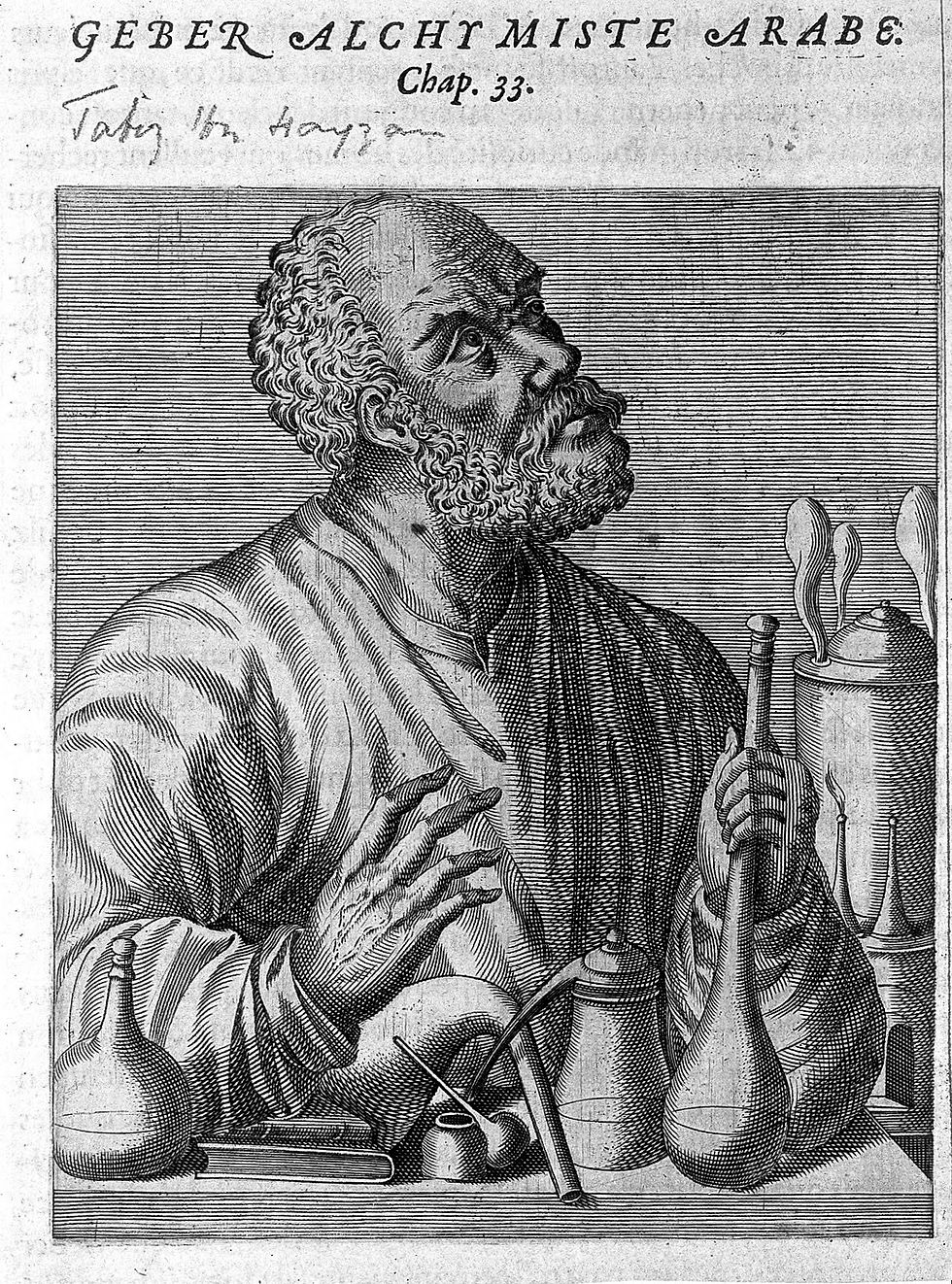
The ground for the legitimacy of alchemy having been laid down, Geber (Jabīr ibn Hayyān) reiterates the argument propounded earlier, citing Aristotle’s Meteorology IV, that boiling is boiling and roasting of a chicken is roasting regardless of where it occurs or by what agency, and “it makes no difference whether it takes place in an artificial or a natural vessel, for the cause if the same in all cases.”[1]In the case of roasting chicken, for instance, the only difference in its production is the way it is cooked. Chicken roasted in the oven and that roasted in volcano produce the same result, i.e. roasted chicken. The only difference then is the kind of agency involved in roasting, and both the essence (fire is fire anywhere) and form (again the form of fire in both cases is the same) are the same. The difference in the efficient causation may mean that there is a difference also in the degree of heating to which the identity of the end result is exposed, but it also means that every difference in substances is due to the degree of exposure they get in their formation. This belief leas Geber to conclude that all metals are made of the same substance, i.e. pure mercury, and that the oily, inflammable substance that is sulphur is a by-product or impurity. If the alchemist restricts himself on using the same ingredients with the ones nature uses, then, since the alchemist can prepare the environment in which metals are produced in nature, he can not only produce what is essentially the same product as what nature makes but also he can hasten the process by starting the process of making at a more advantaged stage. Because he believes that the intrinsic art only assists nature, Geber proposes to cleanse the metals of their impure earth and excessive burning sulphur by means of the radical purification, followed by exposing the metal to quicksilver. The subtilized mercury will be composed of extremely tiny particles that penetrates into the depth of the base metals, which will then adhere to their own purified metallic substance, and thereby add the requisite properties of increased specific weight, resistance to corrosion, altered colour, malleability, and ductility that characterizes a precious metal. In this way, Geber defines gold as a species made up of specific differences such as yellowness, heaviness, and the ability to withstand the assaying tests of cupellation and cementation. Therefore, if the complete set of these specific differences is imposed on a given matter, that matter will necessarily be gold. The consequence of this view is that even a product that does not exist in nature can be natural so long as the methods by which the object has been produced follow the operations of nature.
Because alchemy works with the intrinsic principle of change in matter, as opposed to an architect who does not lead an internal form of perfection, i.e. the building materials have no inherent tendency to become a house, alchemical art must be distinguished from those arts that are merely memetic. Petrus Bonus of Ferrara follows much the same line of argument with Geber, except that he introduces a notion of substantial form. According to Peter, since the perfective arts of medicine and alchemy work with the internal principle of change in matter, a natural form is introduced rather than an artificial form. By this, in building a house, boat, or a ring, one imposes the artificial form bit by bit, as the product is fashioned.[2]Because in absolutely artificial things, such as a house, an architect always preserves the same matter and the name natural form, but varies the artificial forms at will, it does not produce any new form. This is the same with medicine insofar as medicine preserves the body in a healthy condition or leads the ailing body to a state of health, which is nobler than merely memetic arts but still less perfective compared to alchemy, since the latter transmutes, cures, and heals and also induces a new substantial form when it converts one metal into another.
Indeed, while memetic arts only impose accidental forms of each stage of production onto the matter successively, the perfective arts such as alchemy and medicine work with the substantial form – medicine restores the substantial form to its natural state, while alchemy introduces a new substantial form and produces a new substance. In this way, alchemy enabled the alchemists to induce a new substantial form, making it possible to produce something natural even if it does not exist in nature. In turn, because the alchemist can claim to make something that nature itself does not, he can also claim that artificial productions can be better than their natural counterparts. If, however, humans works are better than natural ones, and nature is simply the ordained power of God in the world, where did this place man in relation to God? This will become the staple argument against the legitimacy of alchemy in the years to come. We must mention one more philosopher whose view will exfoliate the possibility alchemy held. A Carmelite professor, Raphael Aversa, gives one of most thorough analyses on whether art can effect the works of nature, with the result that true gold could be made through chymistry. He argues that since inferior metals can be made to by art, such as chymical gold that is quite similar to its natural counterpart, only lacking some of its specific weight or resistance to fire, it should not be impossible to make perfect gold by improving those deficiencies. Aversa further argues that the metals can be made to give up its substantial form, and to assume another substantial form, which results in a substantial conversion. Now, his argument here is twofold: one is that metals can be made superior incrementallyby the gradualappropriation of its sensible qualities, and the other is that a metal can be stripped of its substantial form to take on another substantial form. These are two contradictory statements, since one cannot have a substantial form gradually and incrementally, but one must have it all or not at all. Man cannot be less of a man than another, whose substantial form (of man) is gradually pigmented, as it were. Indeed, by this point, substantial form has ceased to do much of its work and is paving the way for Francis Bacon and the other corpuscularians who held that manifest qualities of gold could be added one-by-one in a process that Bacon called superinduction of forms.
We will now consider those authors who voiced against the views propounded during the last few centuries. The critics anchored their arguments primarily on the issue of substantial forms. As has been pointed out, the proponents for the alchemical gold used the substantial form only as a cloak, a veil, that can be dressed and undressed at the whim of the alchemists. It is important to keep in mind, however, that a substantial form is given in instantii. Further, as Avicenna, Aquinas and Giles of Rome held firmly, the elemental qualities do not themselves combine to form a new substantial form. They only prepare for the forma mixti. Not only can a substantial form be sewed out of a juxtaposition of qualities, but also it is something that cannot be sensed and hence we do not have any access to what the exact characteristics of each substantial form is that differentiates one from another. Because we cannot know exactly what each piece of metal necessarily entails from mere observation, it is impossible to list up all the qualities of a said metal and produce one as perfect as the ones produced in nature. Now, this is a rather surprising position to hold. For their argument essentially comes to saying that since we do not and cannot ever know what qualities each object has in totality, we can never have all the ingredients that compose that particular metal. This makes sense, except that if we do not know exactly what a substantial form entails, how can we be certain that a substantial form has more qualities than we can come to know? Aquinas is adamant in holding that a substantial form of something is only given by nature and not by art when he discusses about whether or not impure water can be used for baptism. Nicholas Eymerich, the inquisitor general of Aragon, in 1376, takes it further and condemns alchemy by linking it to rendering of the help from demons. For Eymerich, the conversion of base metals into gold is an issue of creation rather than mere transmutation. Thus, alchemical success, if it were possible, would be a direct infringement on the divine prerogative. However, since it is not possible to replicate the creative power of God, Eymerich argues, any success that alchemists seem to have must be delusory, i.e. either the product of cheating on their part or the result of demonic intervention.
Following these views, and especially on the notion of substantial form, Alfonso Tostado (1400-1455) reaffirms a correlation between the substantial form and the totality of the accidental qualities that flow from it. The substantial form is, Tostado argued, not a sort of efficient cause acting as a precondition for the production of accidental qualities: instead, it is a certain disposition of the said qualities. Therefore, to say that all accidents of gold can be present without the substantial form of gold is a contradiction in terms. In this way, Tostado reinstituted the essentiality of substantial forms and imposed a strict demarcation between the natural and the artificial on the basis of essence.
However, we will soon see the reorientation of alchemy away from the transmutation of metals and toward the pharmaceutical application of alchemical techniques, framing the new discipline of chymiatria, or chymical medicine (iatrochemistry) in the rise of Paracelsus. While the alchemy of Geber or Alburtus limited itself to the replication and study of inanimate objects, the followers of Paracelsus dedicated themselves to a medical application of alchemical techniques and a veritable chemical physiology. A vehement opponent against these newly emerging theories was a medical professor at the University of Heidelberg, Thomas Erastus. He fervently reiterated the previous views defended by philosophers that man not only cannot transmute metals of different species, but also he cannot even dissolve natural substances into their ingredients. In Erastus’ view, human art is simply incapable of genuinely mixing different substances. All man can do, he argued, is divide substances into small bits that are then juxtaposed. That is not a substantial change, but a mere juxtaposition. A true mixture is absolutely homogeneous, and only God and nature can make a genuine mixture. Human art is the ape of nature and it cannot fabricate substance. Erastus, thus, denies categories that man can remove the form from any substance and thus reduce it into the proximal material from which it was made, for why should we accept that these materials are ingredients rather than mere decomposition products? Does it not follow, he asks, that corpses and cheese would be composed of worms, since they decay into them? A genuine mixture and a new substance is made only when a new substantial form of the mixture (forma mixti) is imposed upon the matter. If art could fabricate substantial forms whenever the artists like, the distinction between art and nature would vanish, for it would then not be a mere external principle but an internal one, hidden and extended within all matter. In other words, art would be identical with nature.
Because when a substantial form conjoins with matter to produce something new is precisely a substantial generation, or a generation of substance, what the alchemists are trying to do to trasmute a new metal by imparting a new substantial form is tantamount to usurping the role of the Creator. In Erastus’ words, “since the origin of substantial form is from God, and the insertion of such a form into matter should be called nothing but themselves – namely putting forms naturally in matter prepared in any fashion – impiously arrogate the works of divinity to themselves.”[3]The alchemists then are nothing but irreligious imposters who assume the power of God and wage war on nature and who see themselves as the equals of God and Nature.
[1]Quoted Aristotle in Newman.
[2]Italicsmine.
[3]Erastus quoted in Newman, 111.


Comments